Dressing for ice floating in Rovaniemi, under the suit and after
On an ice floating trip the operator hands you a thick rescue suit, but what you wear underneath is your job. Warm, close-fitting layers keep you comfortable in the water and on the walk back to the cabin. The same clothes then have to cope with Lapland air on the way home.
The suit goes on over your clothes
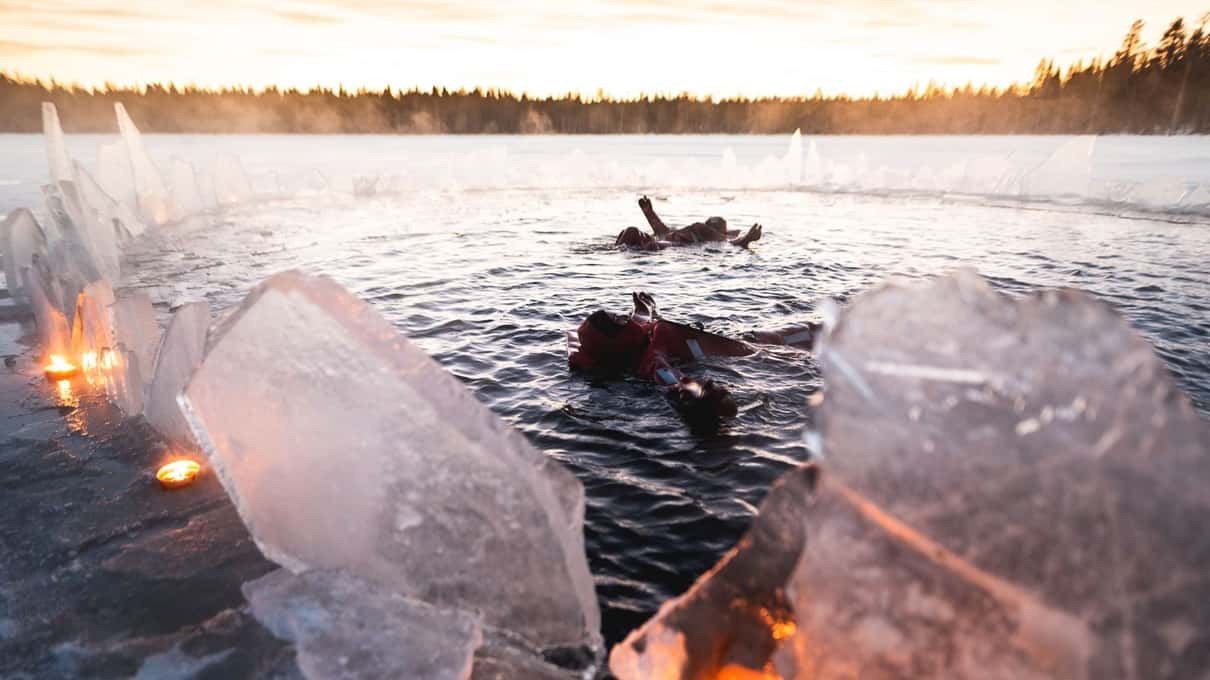
Every float near Rovaniemi uses a waterproof, insulated rescue suit that you climb into fully dressed. It seals around your face and keeps the lake water outside, so you do not get wet and you do not swim. You lie back and let the suit hold you up.
That means your own clothes do two jobs. They keep you warm inside the suit while you drift in water close to freezing, and they keep you warm before and after, when you stand on the ice or ride back to town in the minibus.
Suits like these come from sea rescue, where an immersion suit keeps a sailor dry and floating. They are roomy, but not endlessly so. A bulky ski jacket will not fit under one, and the guide will ask you to take it off before you zip up.
How cold the air gets around Rovaniemi
January in Rovaniemi is often somewhere between -10 and -25 °C (14 to -13 °F), and colder snaps happen. Wind across an open lake makes it feel harsher. Your face is the only part of you outside the suit, and it notices.
The water itself is warmer than the air, around 1 °C (34 °F) according to one reviewer. Several floaters said the moment they felt coldest was not in the hole but standing on the ice afterwards, peeling the suit off. Plan your layers for that minute too.
The evening float is the colder of the two lake trips, simply because the sun has gone. Still undecided between the two? Our daylight against aurora comparison sets out what else changes after dark.
Layers that fit under a rescue suit
Think of a ski day without the outer shell. Start with thermal long underwear in wool or a synthetic fabric. Cotton stays cold once it gets damp from sweat or a leaky seam.
- Thermal long underwear for your top half and your legs
- A fleece or thin wool sweater
- Warm trousers that are not stiff or bulky
- Wool socks, plus a spare pair in your bag
- A warm hat for before and after the float
Skip anything with a hard belt buckle or a thick hood that bunches at the neck. The suit should close smoothly around your face, and lumps underneath make that harder for the guide to adjust.
Leave rings and other jewelry in your room before the pickup, or keep them in a zipped pocket. The guides ask floaters to remove jewelry and bulky jackets, and a lost ring at the bottom of a frozen lake stays there.
Feet and hands, the usual complaint
Cold hands and feet come up in reviews more than anything else. The suit covers them, but extremities lose heat first, and a long float slowly lets the chill in. Thick wool socks make the biggest difference.
Nordic Adventures' GetYourGuide listing asks you to bring socks, which is a hint in itself. Reviewers on several floats found their suit wet inside, usually around the feet. One reviewer on another trip swapped wet socks for a dry pair the guides provided, but do not count on that.
Pack a second pair of socks in a plastic bag and change into them in the cabin. Dry feet for the ride home feel better than any hot drink. For the full sequence from pickup to cabin, read what happens in the water.
Dressing for the aurora float
The aurora ice float from ~$138 runs after dark and in all weather, and it can be a long evening outdoors. You may stand on the ice watching the sky before or after your turn in the water.
Viator's listing mentions a campfire and a heated cabin. Cookies come with hot berry juice or glögi to warm you up. That helps, yet your outer layer for the evening should be your warmest jacket, worn over the clothes that go under the suit. Mittens beat gloves when you are standing still.
Your phone stays behind when you float, so the guide's camera does the work in the water. Our page on your chances of an aurora covers what the sky may or may not do.
Night on the lake, warmly dressed
The Nordic Adventures evening float picks you up at your hotel and ends with hot drinks by a fire. On a clear night the lights may show up over the lake.
Packing for an icebreaker day
The two cruises on the Bothnian Bay are full-day outings with a lot of time outdoors on deck and on the sea ice. Wear proper winter outdoor clothing and warm shoes with a good grip, since you walk on the frozen sea when conditions allow.
A change of clothes earns its place in the bag. One Sampo reviewer found the suit damp inside, and nobody wants to sit on a bus for close to two hours in wet layers. Our comparison of the Sampo and Polar Explorer covers the day itself.
Bring sunglasses if you travel late in the winter. The icebreaker listings mention the spring glare off the ice, and a bright March afternoon on white sea ice is hard on the eyes. A passport also goes in the bag for the Polar Explorer, which sails from Sweden.
What stays at the hotel
Big bags are not allowed, and there is nowhere to keep them dry on the ice anyway. A small backpack with spare socks and a hat is enough for the lake trips, with your phone tucked in an inner pocket.
Leave valuables you do not need, and charge your phone before the trip, since cold drains batteries quickly. Keep it close to your body in a pocket. If you are still deciding which outing fits your budget, our ice floating price guide sets the tours side by side.